(De)constructing Singularity
(De)constructing Singularity
(De)constructing Singularity
When machines perceive space and humans navigate time, whose singularity are we constructing—and can duration itself become material?
When machines perceive space and humans navigate time, whose singularity are we constructing—and can duration itself become material?
When machines perceive space and humans navigate time, whose singularity are we constructing—and can duration itself become material?
Type
Type
Writing
Writing
Year
Year
2025
2025
Fields
Fields
Spatial Intelligence, Temporal Intelligence, Full Dimensional Film
Spatial Intelligence, Temporal Intelligence, Full Dimensional Film
Synopsis
Synopsis
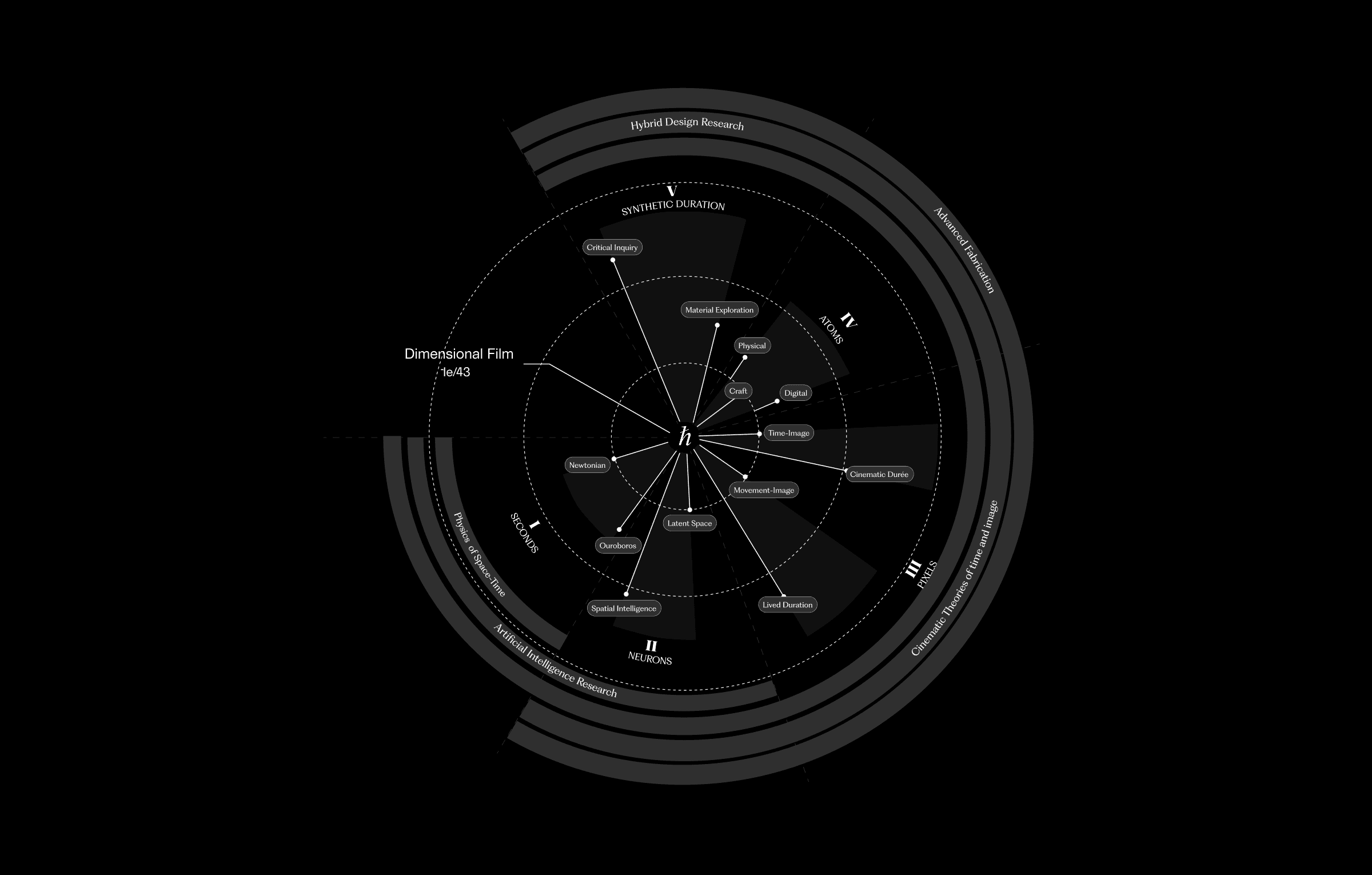
(De)constructing Singularity: The Fabrication of Synthetic Duration examines how spatial intelligence, machine vision, and advanced fabrication converge to dissolve the boundary between perception and production. This research framework positions duration not as temporal flow but as synthetic material—something manufactured through the interplay of biological cognition, artificial intelligence, and physical making. Across projects spanning computational design, cinematic theory, robotic manufacturing, and responsive environments, 1e-43 investigates how architecture might encode experience as its primary structural logic. The work asks whether emerging technologies enable us to construct spaces that exist not as fixed forms but as temporal artifacts—architectures that materialize only through continuous acts of inhabitation, observation, and algorithmic negotiation. By interrogating the singularity where human perception meets machine intelligence, this research explores fabrication as both technical process and ontological condition.
(De)constructing Singularity: The Fabrication of Synthetic Duration examines how spatial intelligence, machine vision, and advanced fabrication converge to dissolve the boundary between perception and production. This research framework positions duration not as temporal flow but as synthetic material—something manufactured through the interplay of biological cognition, artificial intelligence, and physical making. Across projects spanning computational design, cinematic theory, robotic manufacturing, and responsive environments, 1e-43 investigates how architecture might encode experience as its primary structural logic. The work asks whether emerging technologies enable us to construct spaces that exist not as fixed forms but as temporal artifacts—architectures that materialize only through continuous acts of inhabitation, observation, and algorithmic negotiation. By interrogating the singularity where human perception meets machine intelligence, this research explores fabrication as both technical process and ontological condition.
LINKS
Credits
Noah Jenkins
Creative Director
Isabella Brooks
Designer
James Hughes
Motion Designer
Maria White
Copywriter
Links
More works